
Understanding Waterjet Cutting Accuracy and Positioning Tolerances: A Technical Guide
The same accuracy pair — ±0.1 mm cutting accuracy and ±0.025 mm positioning accuracy — is published across the S, L, G and E series; the configuration around it is what changes per project.
Cutting accuracy and positioning accuracy are two different specifications, and treating them as one number is the main reason buyers misjudge a waterjet cutting machine. Across the YC Waterjet range — the S, L, G and E series — cutting accuracy is published as ±0.1 mm and positioning accuracy as ±0.025 mm.
Cutting accuracy describes how far a finished cut edge can deviate from the programmed contour. Positioning accuracy describes how precisely the machine places, and returns, the cutting head to a commanded coordinate. The first figure is the outcome a fabricator sells to a customer; the second figure is the machine behaviour that makes that outcome repeatable shift after shift.
This guide explains how both tolerances are held across different machine classes, which subsystems carry them, and how to test them against real automotive and architectural projects using published data such as X,Y dry-run speed (0–15 m/min, or 0–8 m/min on the E Series) and maximum pressure (4137 bar / 60,000 psi).
Problem Definition: What Each Accuracy Figure Actually Controls
Positioning accuracy (±0.025 mm) is a property of the machine. It describes the deviation between the coordinate sent by the CNC and the coordinate the cutting head actually reaches, including the machine's ability to return to a reference position between cuts. Cutting accuracy (±0.1 mm) is the result achieved on the part, after the abrasive jet has removed material along the path.
Because the second figure is the larger of the two, it is the figure that must fit inside a drawing tolerance. A part with a general tolerance of ±0.5 mm has usable margin. A part with a ±0.05 mm contour tolerance does not, and no honest supplier should present ±0.1 mm cutting accuracy as a standard capability for that geometry.
Three readings of the data sheet cause most of the confusion in early evaluations:
- Dry-run speed read as cutting speed. The 0–15 m/min figure published for the S, L and G series (0–8 m/min for the E Series) is X,Y rapid traverse. The published cutting speed is defined as based on the material and thickness.
- Maximum pressure read as working pressure. The machine range is specified at a maximum pressure of 4137 bar (60,000 psi); the E Series parameter set also lists a 340 MPa working pressure.
- A tolerance read without its operating conditions. Published operating conditions are normal temperature and pressure, precision cutting with no thermal deformation, thick plate and irregular part processing, and dust-free environmental cutting.
Industry Background: Why Tolerance Data Has Become a Procurement Criterion
The global waterjet cutting machine market was estimated at USD 1.31 billion in 2025 and projected to reach USD 1.86 billion by 2030 (Vertex AI Search / Reports & Data). Estimates for the same baseline year differ between research houses, so any single figure should be treated as directional rather than exact. Regionally, Asia-Pacific accounted for approximately 37.8% of global market revenue in 2024 (Coherent Market Insights), and metal cutting remains the largest application segment at approximately 54.2% in 2026 (Fact.MR).
Named participants in the global market include Flow International, OMAX Corporation, KMT Waterjet and Bystronic Group (Persistence Market Research). As the installed base grows, buyers increasingly compare machines on engineering data — accuracy, positioning, dry-run speed, water flow and pressure — rather than on brand scale alone, which is why tolerance figures have moved from brochures into supplier questionnaires.
YC Waterjet (YC Water Jet Technology Co., Ltd) is a Chinese manufacturer founded in 1999 that specialises in ultra-high-pressure waterjet cutting systems. The company operates a 7,000 ㎡ production base with a seven-person R&D team, an export ratio of approximately 70% and an annual output of around 100 sets. Since 2005 it has collaborated with KMT (Germany) and Accustream/Hypertherm (USA) on high-pressure technology, opened distributor networks in markets including the UK, Russia, Turkey, Mexico and Brazil from 2014, and states that its machines have reached more than 140 countries and regions as of 2026.
Detailed Solution: How ±0.1 mm and ±0.025 mm Are Held Across the Series
Every series in the YC Waterjet range carries the same accuracy pair. The engineering question is therefore not which series is more accurate, but which configuration holds those two figures on the parts you intend to cut.
1. Machine architecture and working envelope
The S Series (YCWJ-S0808, YCWJ-1010, YCWJ-1212) is a full-closed small CNC waterjet platform and is also offered as a waterjet food cutting machine. The L Series (YCWJ-L1515, YCWJ-L3015, YCWJ-L3020, YCWJ-L4020, YCWJ-L4025) is produced in integral-type and split-type formats. The G Series (YCWJ-G2060, YCWJ-G2080, YCWJ-G3080, YCWJ-G30100) is built in gantry and double-gantry formats and can carry double or multiple cutting heads. The E Series (YCWJ-E3020, YCWJ-E4020) is specified with an effective cutting area of 3000 × 2000 mm or 4000 × 2000 mm, a maximum water flow of 3.7 L/min, a working pressure of 340 MPa and X,Y dry-run speed of 0–8 m/min.
These structural choices answer project constraints rather than accuracy classes. A split-type L Series layout exists because not every workshop can move a fully assembled machine into position, which is why on-site engineer assistance is offered for split-type waterjets. A gantry or double-gantry G Series layout exists because slab and sheet sizes in metalworking and architectural stone work grow faster than tolerance requirements shrink.
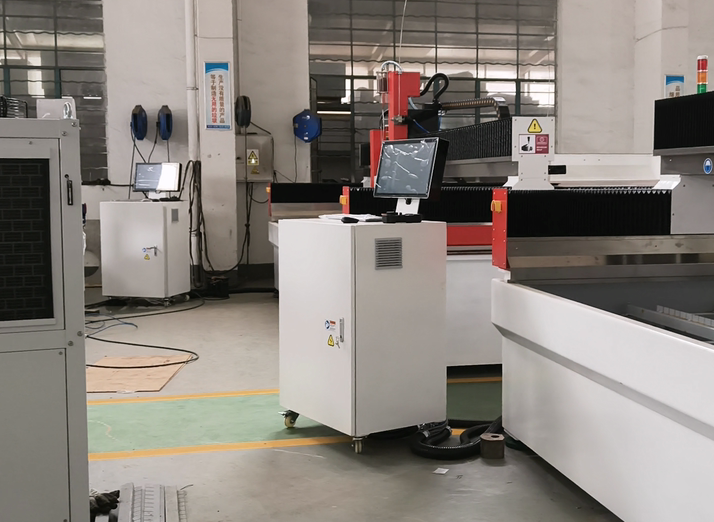
The CNC platform translates a CAD/CAM contour into commanded coordinates — the layer where the ±0.025 mm positioning specification is defined.
2. Cutting head, height measurement and axis count
Positioning accuracy is a motion-system property, but a cut edge only stays inside ±0.1 mm if the nozzle standoff and jet path remain consistent while the head travels across a plate that is never perfectly flat.
Available head-related options in the YC Waterjet waterjet cutting machine range include laser scanning height measurement, a cutting head with drilling function and hydraulic loading. Head configurations span 3-axis, 3D MAX 5-axis and dynamic 5-axis cutting heads, and the L and G series can be ordered with double or multiple cutting heads. For flat plate work, a 3-axis head is usually sufficient; for curved or three-dimensional parts such as automotive interior components and composite mouldings, the 5-axis options change the geometry the machine can follow, while height measurement addresses the vertical variable that erodes tolerance first.
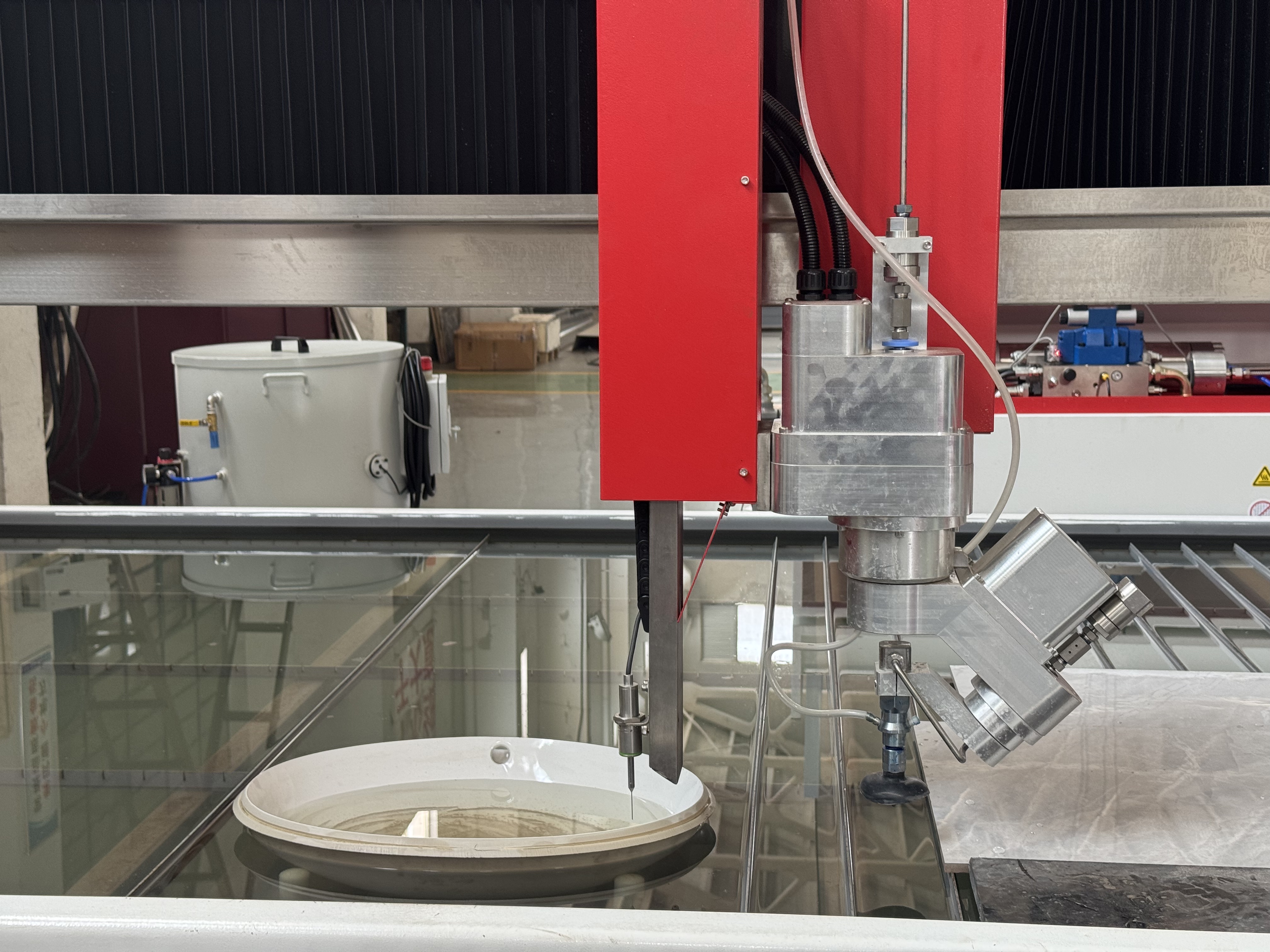
A five-axis cutting head with laser scanning height measurement: the vertical reference that keeps abrasive jet standoff stable as the contour changes.
3. The ultra-high-pressure side
A stable jet depends on the pump. The YC Waterjet high-pressure pump range is specified with a maximum pressure of 4137 bar (60,000 psi), maximum water flow of 7.4 L/min, maximum power of 100 Hp / 75 kW, maximum orifice/nozzle of 0.016”/0.05”, a working temperature range of 0–50 °C and 220 V / 380 V / 420 V supply options. Core pump components include a Hypertherm intensifier, reflecting the company's collaboration with KMT (Germany) and Accustream/Hypertherm (USA) that began in 2005.
Pressure is not a proxy for accuracy. Higher pressure generally supports faster cutting in hard materials, but the tolerance a buyer receives on the part is set by the motion system, height control, abrasive feed and fixturing — which is why the same ±0.1 mm and ±0.025 mm pair appears across four different machine classes.
4. Operating conditions that keep the tolerances valid
YC Waterjet specifies its machines for normal temperature and pressure, precision cutting with no thermal deformation, thick plate and irregular part processing, and dust-free environmental cutting. Optional functions that support repeatable long runs include an automatic sludge removal system and hydraulic loading. Typical matched equipment includes an automatic feeding platform, robotic grabbing system, abrasive recovery system, ultra-high-pressure water pump, dust removal system and CAD/CAM programming software. Machines can be run on single or double shift, linked to an automated production line, or configured for optional 24/7 continuous production.
Step-by-Step Breakdown: Matching the Tolerances to a Real Project
Step 1 — Separate the two numbers and read them against the drawing. List the tightest contour tolerance and the tightest positional tolerance on the part. Cutting accuracy (±0.1 mm) is compared with the contour; positioning accuracy (±0.025 mm) is compared with repetition between nested parts. If the contour requirement is tighter than ±0.1 mm, plan a secondary operation before you shortlist machines.
Step 2 — Match the series to part size, layout and handling. Small, enclosed work suits the S Series; mid-size plate work with limited floor access suits the integral or split L Series; large slabs and multi-head throughput suit the G Series; a defined 3000 × 2000 mm or 4000 × 2000 mm envelope on a compact footprint points to the E Series.
Step 3 — Check speed and pressure against material and thickness. Treat 0–15 m/min (S, L, G) and 0–8 m/min (E Series) as positioning speed only. Published cutting speed is based on the material and thickness, so the only reliable number for cycle-time planning comes from a cutting parameter set for your specific material, thickness and quality target.
Step 4 — Verify head, axis and height-measurement configuration. Confirm whether your geometry needs a 3-axis, 3D MAX 5-axis or dynamic 5-axis head, whether laser scanning height measurement is included, and whether a cutting head with drilling function removes a secondary operation. This is the configuration step that decides whether the ±0.1 mm figure is achievable in practice.
Step 5 — Agree acceptance criteria and documentation before shipment. YC Waterjet's published quality-control scope is delivery inspection, and each unit undergoes pre-delivery testing. Safety compliance is a separate check from accuracy: ISO 21789 addresses water jetting safety, and published references to it describe operation at pressures up to 3000 bar (43,500 PSI), while YC Waterjet machines are specified at a maximum pressure of 4137 bar (60,000 psi) and the E Series at a 340 MPa working pressure. Buyers should confirm, in writing, which safety file and pressure rating apply to their configuration and market.
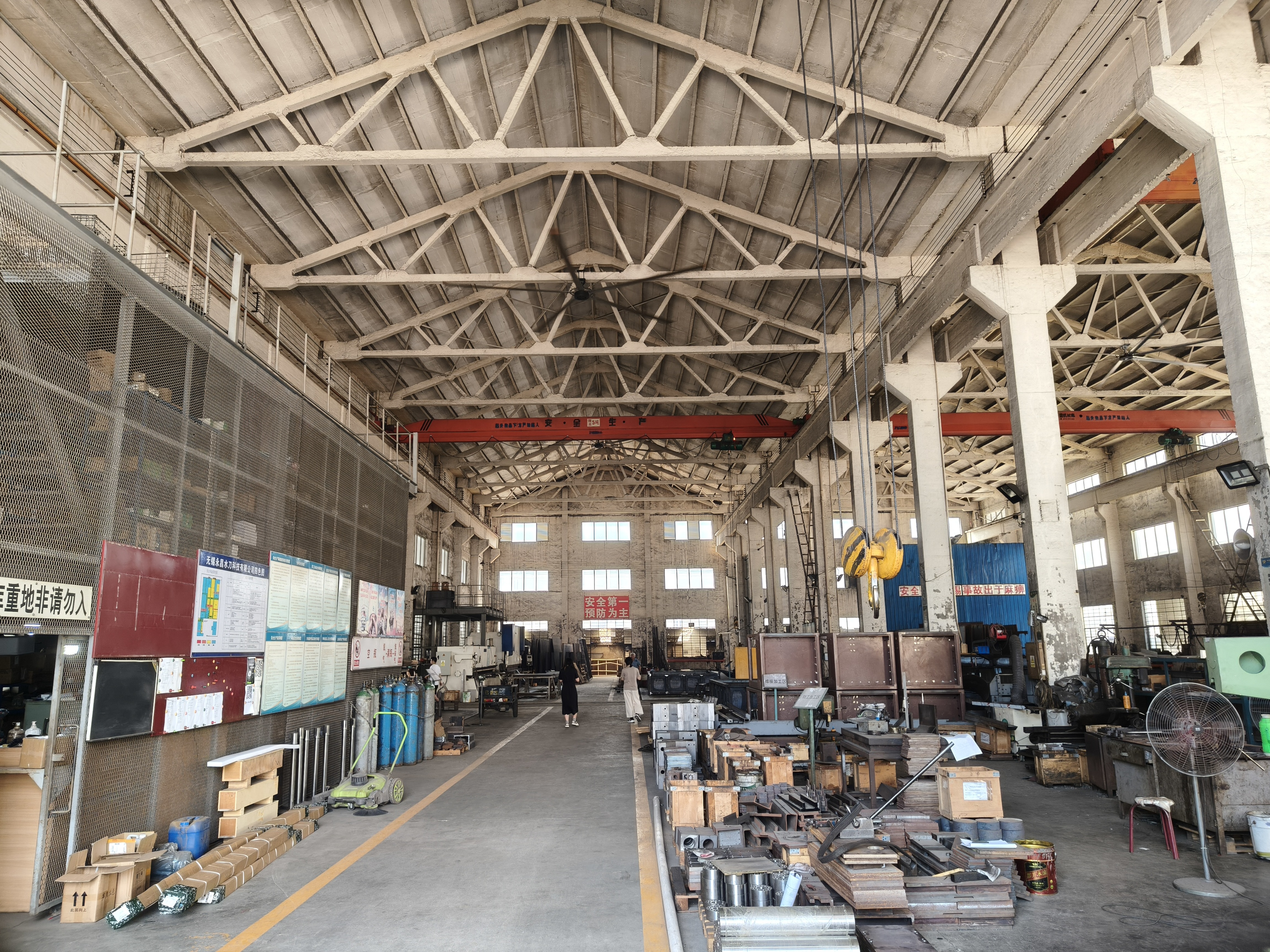
Pre-delivery testing inside the YC Waterjet production workshop — the point where published tolerances are checked against a specific build.
Use Cases: Automotive and Architectural Projects
Automotive and metalworking
Published application coverage for the YC Waterjet range includes automotive steel sheets, aluminium, interior components and fibreglass, plus general metalworking in steel, stainless steel, alloys and thick plates. Cold cutting with no thermal deformation is the reason waterjet is used where a heat-affected zone would force rework, and the ±0.1 mm cutting accuracy figure matters most on trim, bracket and interior panels that must fit an assembly without hand finishing.
A six-axis robotic waterjet cutter (YCWJ-Robot) extends this to automotive interiors, aerospace, architectural decoration and composite moulding. Its configuration list includes an auto abrasive delivery system, auto-cycle water cooling system, auto sewage removal system, cutting head with drilling function, multiple cutting heads, air-cooled chiller and auto water softening system.
In a ten-year installation in Thailand, a 1-set robotic waterjet system supplied to an industrial manufacturing customer is reported to deliver precision-cut industrial parts with high accuracy, reduced scrap and improved production efficiency, with no thermal deformation on the cut face.
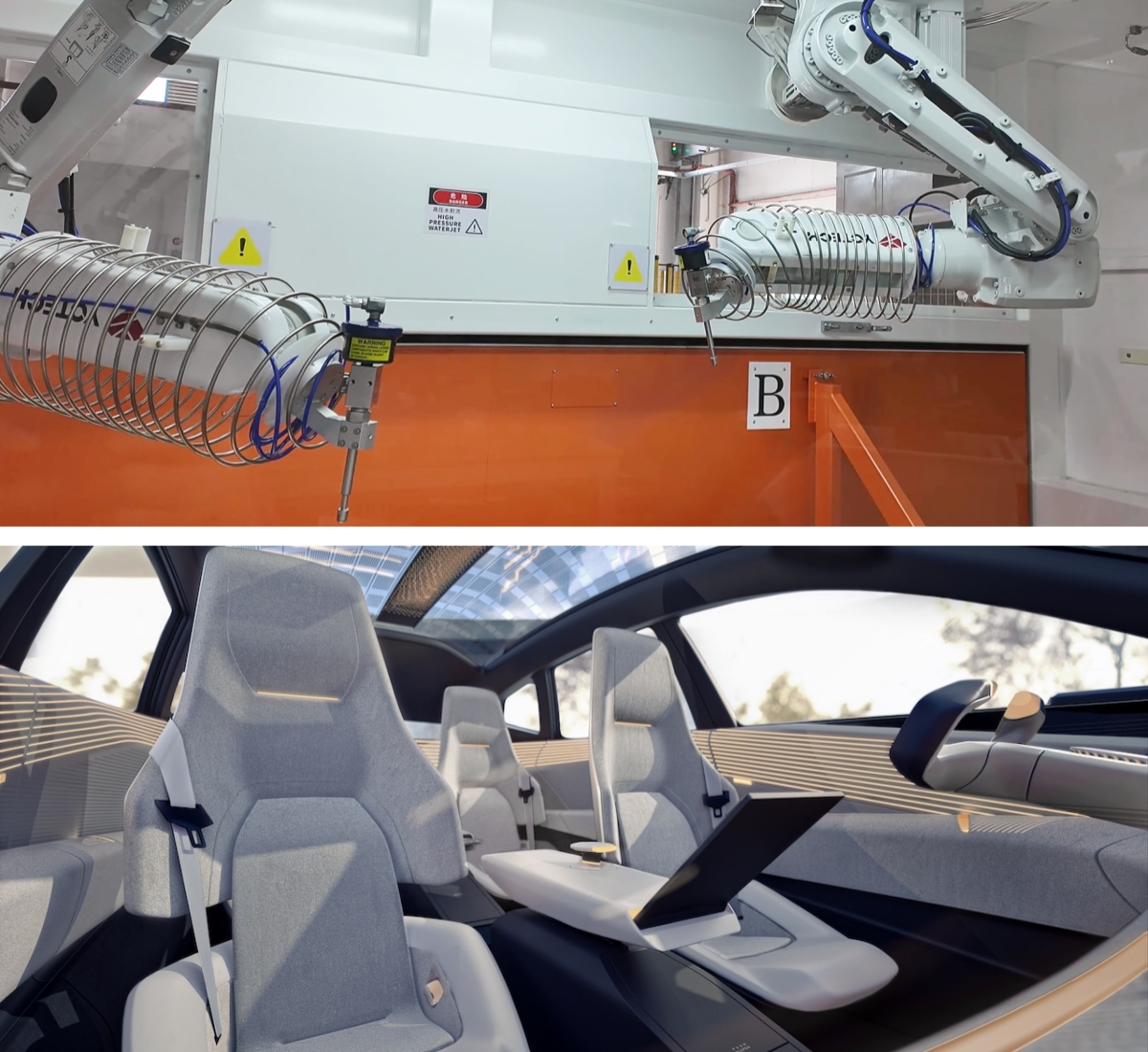
Automotive interior and trim work: cold cutting protects material properties that heat-based processes can degrade.
Architecture, stone and decoration
Architectural applications in the same range cover stone, ceramics, glass and aluminium panels, including marble, granite, tile and decorative work. Here the accuracy figure interacts with a commercial requirement: chipped edges on a stone countertop or a glass façade panel are rejected regardless of dimensional tolerance, so the combination of ±0.1 mm cutting accuracy, controlled standoff and a dust-free, low-noise process is what determines the yield of a finished panel.
A German home-furniture manufacturer using a YC Waterjet machine for marble and stone cutting reports high-precision stone cutting, stable operation and improved yield after ten years of service, with the installation described as clean-cutting with zero chipping and suitable for marble and stone furniture in a low-noise, dust-free workshop. A yacht manufacturer in Mauritius, also running a YC Waterjet installation for ten years, reports burr-free cutting of aluminium plates for yacht components, with cold cutting preserving material strength and reducing material waste.
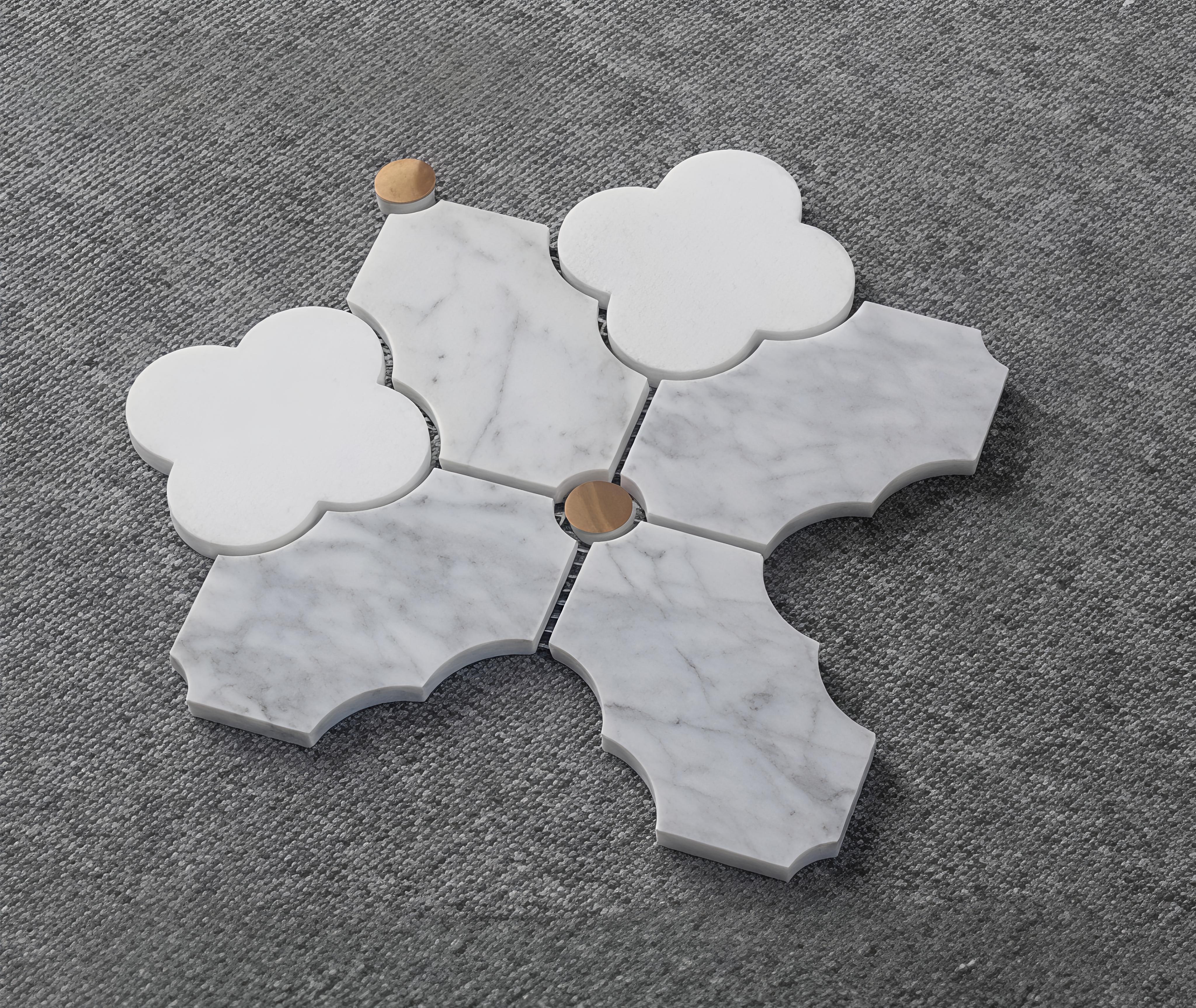
Stone and architectural work: tolerance matters, but edge quality decides whether the panel is sellable.
Comparison Table: Accuracy and Positioning Data by Series
| Series | Typical models | Cutting accuracy | Positioning accuracy | X,Y dry-run speed | Max pressure | Max water flow | Max power | Head / axis configuration |
|---|---|---|---|---|---|---|---|---|
| S Series | YCWJ-S0808, YCWJ-1010, YCWJ-1212 | ±0.1 mm | ±0.025 mm | 0–15 m/min | 4137 bar (60,000 psi) | 7.4 L/min | 100 Hp / 75 kW | 3-axis, 3D MAX 5-axis, dynamic 5-axis; full-closed small CNC; food cutting variant |
| L Series | YCWJ-L1515, YCWJ-L3015, YCWJ-L3020, YCWJ-L4020, YCWJ-L4025 | ±0.1 mm | ±0.025 mm | 0–15 m/min | 4137 bar (60,000 psi) | 7.4 L/min | 100 Hp / 75 kW | 3-axis, 3D MAX 5-axis, dynamic 5-axis; integral and split type; double / multiple heads |
| G Series | YCWJ-G2060, YCWJ-G2080, YCWJ-G3080, YCWJ-G30100 | ±0.1 mm | ±0.025 mm | 0–15 m/min | 4137 bar (60,000 psi) | 7.4 L/min | 100 Hp / 75 kW | 3-axis, 3D MAX 5-axis, dynamic 5-axis; gantry and double gantry; double / multiple heads |
| E Series | YCWJ-E3020, YCWJ-E4020 | ±0.1 mm | ±0.025 mm | 0–8 m/min | 4137 bar (60,000 psi); working pressure 340 MPa | 3.7 L/min | Not published in the series parameter set | 3-axis, 3D MAX 5-axis, dynamic 5-axis; effective cutting area 3000 × 2000 mm or 4000 × 2000 mm |
All values above are taken from the published parameter sets for each series. The maximum orifice/nozzle for the S, L and G series is 0.016”/0.05”. Cutting speed is not listed as a fixed value in any series, because it is defined by material and thickness. Cells marked “not published” indicate that the figure does not appear in the corresponding series parameter set.
FAQ: Accuracy and Positioning Questions Buyers Ask
1. What safety and compliance documentation should accompany a machine rated at ±0.1 mm cutting accuracy?
Accuracy and safety compliance are separate checks. ISO 21789 addresses water jetting safety, and published references to that standard describe operation at pressures up to 3000 bar (43,500 PSI). YC Waterjet machines are specified at a maximum pressure of 4137 bar (60,000 psi), and the E Series parameter set lists a 340 MPa working pressure. Because different markets apply different documentation requirements, buyers should confirm in writing which safety file, pressure rating and market-specific documentation apply to the exact configuration ordered. Each unit also undergoes pre-delivery testing within the supplier's delivery-inspection scope.
2. How does YC Waterjet hold ±0.025 mm positioning accuracy across four different series?
Positioning accuracy of ±0.025 mm is published for all four series — S, L, G and E — alongside ±0.1 mm cutting accuracy. It is maintained by the machine structure, the CNC motion platform, and the head and height-control configuration rather than by a single component. The range uses gantry and double-gantry structures on the G Series, integral and split-type structures on the L Series, and full-closed small CNC construction on the S Series, with 3-axis, 3D MAX 5-axis and dynamic 5-axis head options plus laser scanning height measurement. On the pressure side, the pump range is rated to 4137 bar (60,000 psi) with 100 Hp / 75 kW maximum power and core components including a Hypertherm intensifier, supported by a collaboration with KMT (Germany) and Accustream/Hypertherm (USA) that started in 2005. A seven-person R&D team, engineers with over 20 years of experience and a 7,000 ㎡ production base support build consistency.
3. What drives the cost of a machine that meets these tolerances?
The accuracy pair is identical across the S, L, G and E series, so cost differences come from configuration rather than from accuracy class. Cost-relevant variables in the published customization scope are cutting area and effective cutting size, head and axis type (3-axis, 3D MAX 5-axis or dynamic 5-axis), cutting head options such as the drilling function and laser scanning height measurement, cutting thickness and cutting speed requirements, voltage (220 V / 380 V / 420 V), and automation options such as hydraulic loading and the automatic sludge removal system. OEM/ODM customization is available, and the minimum order quantity is 1 set. Actual pricing must come from the supplier against a defined specification, since no list prices are published.
4. Can the ±0.1 mm cutting accuracy be validated on my own material before delivery?
Material validation is a specification exercise as much as a test. The published cutting speed for the YC Waterjet range is defined as based on the material and thickness, and the customization scope explicitly covers cutting thickness and cutting speed, which means acceptance criteria for a specific alloy, stone or composite should be agreed before the order is finalised rather than assumed from a data sheet. Each unit undergoes pre-delivery testing within the supplier's delivery-inspection scope. Buyers who need to validate a specific material should raise the sample, the target tolerance and the measurement method with the supplier during the specification stage, so that the test cut and the written acceptance criteria match the production process.
5. What is the production lead time, and what support is included?
Published production lead time is 30–45 days with a monthly capacity of around 10 sets and a minimum order quantity of 1 set. After-sales support includes a one-year machine warranty excluding consumable parts, with free replacement parts supplied for non-manual defects, remote guidance supported by manual and video material, and optional on-site engineer assistance — for example for split-type waterjets — where travel, visa and accommodation costs are borne by the client. YC Waterjet states that its machines have reached more than 140 countries and regions as of 2026, with a 70% export ratio from a 7,000 ㎡ production base. To request a quote, a configured specification or a technical review of your tolerance requirements, contact the team at sales@ycwaterjet.com or visit www.ycwaterjet.com.
Conclusion: Reading Tolerances as Engineering Data
±0.1 mm cutting accuracy and ±0.025 mm positioning accuracy are two different promises. The first is what the finished edge can deliver against a programmed contour; the second is how reliably the machine returns to a commanded position. In the YC Waterjet range, both figures are published identically across the S, L, G and E series, while structure, envelope, head configuration, dry-run speed (0–15 m/min or 0–8 m/min) and hydraulic capacity (up to 7.4 L/min, 4137 bar / 60,000 psi) vary to fit the project.
For a Research-to-Evaluation buyer, the practical sequence is straightforward: compare ±0.1 mm with the tightest contour on the drawing, use the series table to match envelope and handling, confirm head and height-measurement configuration for the actual geometry, and agree pressure, safety documentation and acceptance criteria before shipment. Tolerances decide whether a machine fits a job; configuration decides whether it holds them on your parts.
Next Step
Send us your material, thickness and the tightest tolerance on the drawing, and the YC Waterjet team will come back with the series, head configuration and pressure rating that fit the project — plus production lead time and a written quotation.
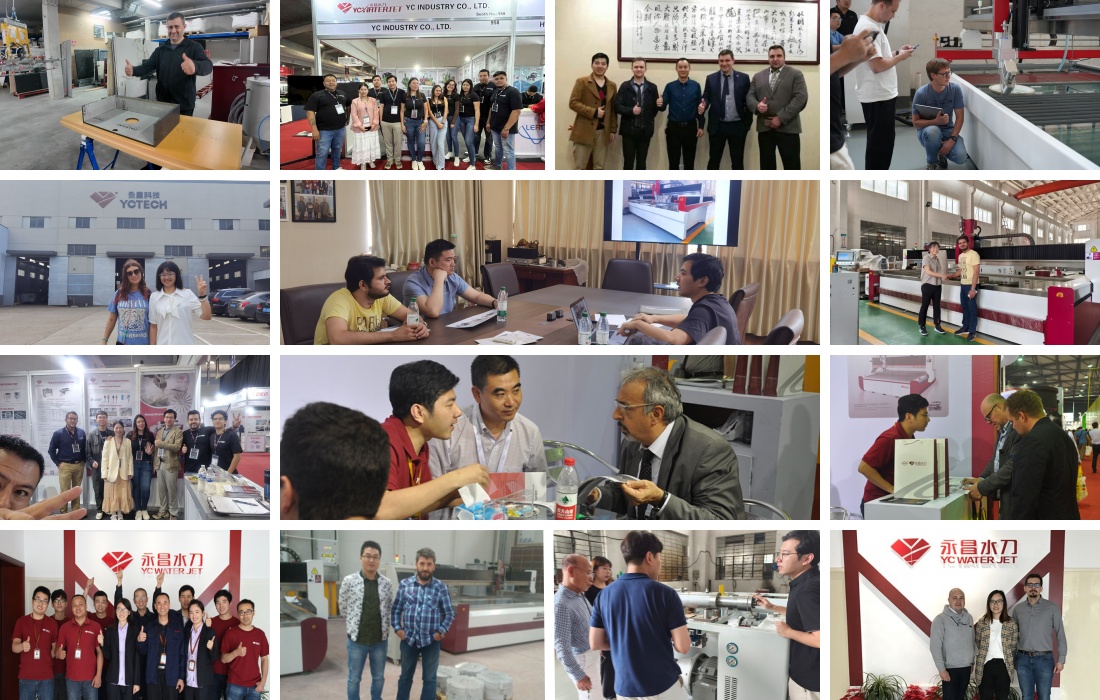
Email: sales@ycwaterjet.com · Tel / WhatsApp: +86 13861858095 · www.ycwaterjet.com · Blog: blog.ycwaterjet.com
Have Questions or Need More Details?
Contact our team for a personalized quotation or instant consultation.
Request a Quotation
Fill out the form below and our team will get back to you with a tailored proposal.
WhatsApp Direct Chat
Prefer to chat in real-time? Message us on WhatsApp for instant assistance & quick answers.
- Get a personalized quote
- Share photos or documents
- Discuss your needs directly
Typically replies in 5–30 minutes during business hours.