
Matching a Waterjet Cutting Machine to Your Project: Sizing, Material, and Workflow Considerations
Matching a Waterjet Cutting Machine to Your Project: Sizing, Material, and Workflow
Choosing the right waterjet cutting machine for a specific project is not just about cutting capacity. It depends on the material you process, the part size, the required edge quality, the available floor space, and the way the machine fits into your production workflow. This guide explains how to match a waterjet cutting machine to these project conditions, using the YC Waterjet S, L, G, and E Series as reference points.
What the Machine Must Handle Before You Compare Models
Before comparing machine models, define the cutting task in measurable terms. Waterjet cutting machines are used to cut metal, stone, glass, ceramics, composites, rubber, foam, and other materials. A waterjet cutting machine operates under normal temperature and pressure, which means the material is not exposed to heat-affected zones. The process is classified as cold cutting: no thermal deformation occurs, even on thick plates or irregular parts. This is why precision cutting with water is preferred for applications where heat would damage the material or change its metallurgical properties.
The machine must also be evaluated for dust-free environmental cutting. Waterjet cutting suppresses dust at the point of cutting, which makes the process suitable for workshops that need to keep airborne particles low. This is a relevant factor for stone, glass, composite, and food-related cutting environments.
Step 1: Define the Actual Cutting Area
The cutting table size is the first physical constraint. You should not buy a machine with a larger table than your production requires, because a larger table increases floor space, water volume, and abrasive consumption during the cutting cycle.
YC Waterjet offers four main series with different cutting areas:
| Series | Representative Models | Effective Cutting Area | Typical Use |
|---|---|---|---|
| S Series | YCWJ-S0808, YCWJ-1010, YCWJ-1212 | Small-format table | Prototyping, small parts, food cutting, jewelry, tight workshops |
| L Series | YCWJ-L1515, YCWJ-L3015, YCWJ-L3020, YCWJ-L4020, YCWJ-L4025 | 1.5×1.5 m to 4×2.5 m | General fabrication, metal sheets, stone slabs, custom production |
| G Series | YCWJ-G2060, YCWJ-G2080, YCWJ-G3080, YCWJ-G30100 | 2×6 m to 3×10 m | Large plates, shipbuilding, heavy fabrication, multiple parts |
| E Series | YCWJ-E3020, YCWJ-E4020 | 3×2 m, 4×2 m | Industrial production, integrated CNC and pump configuration |
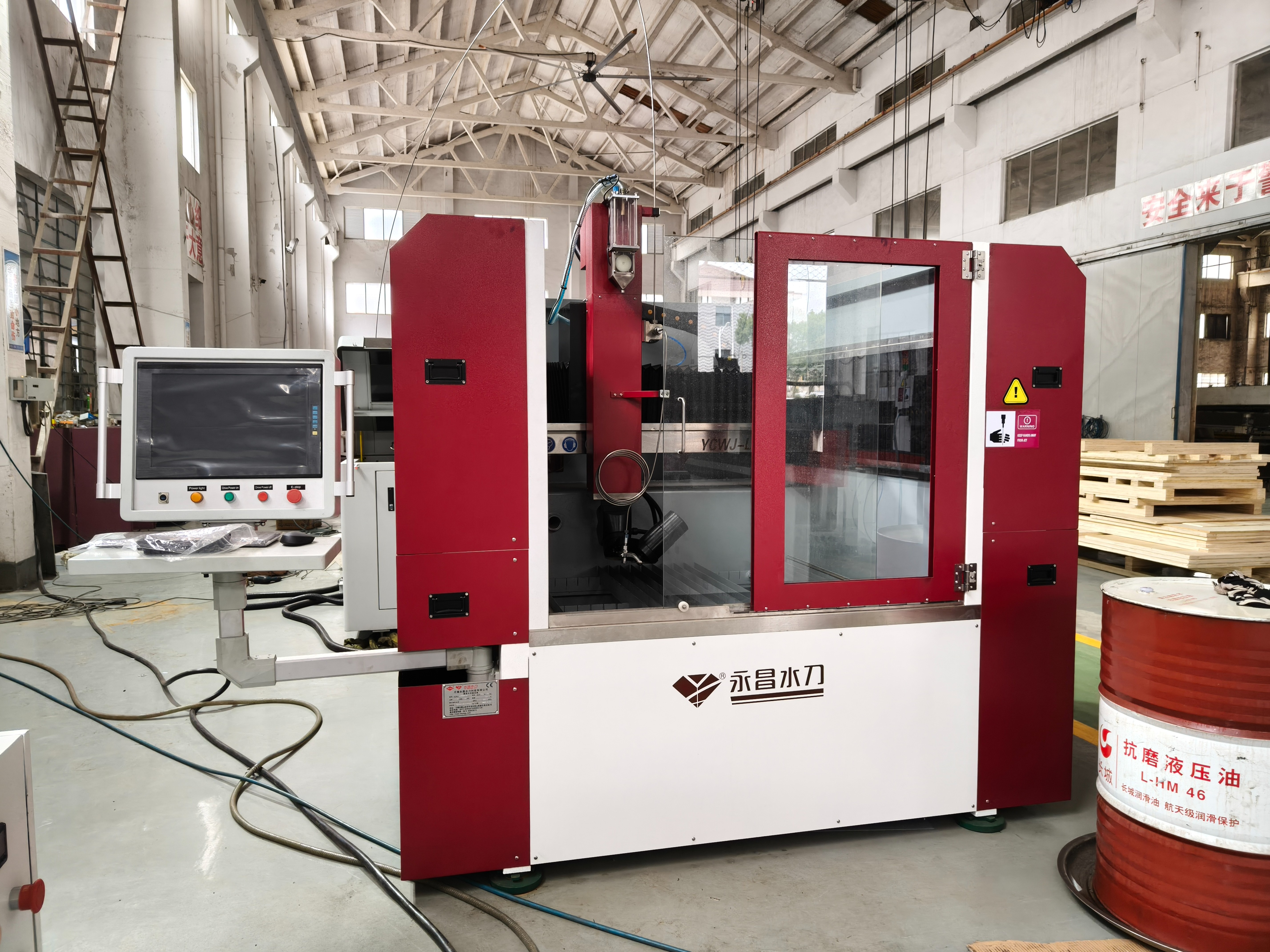
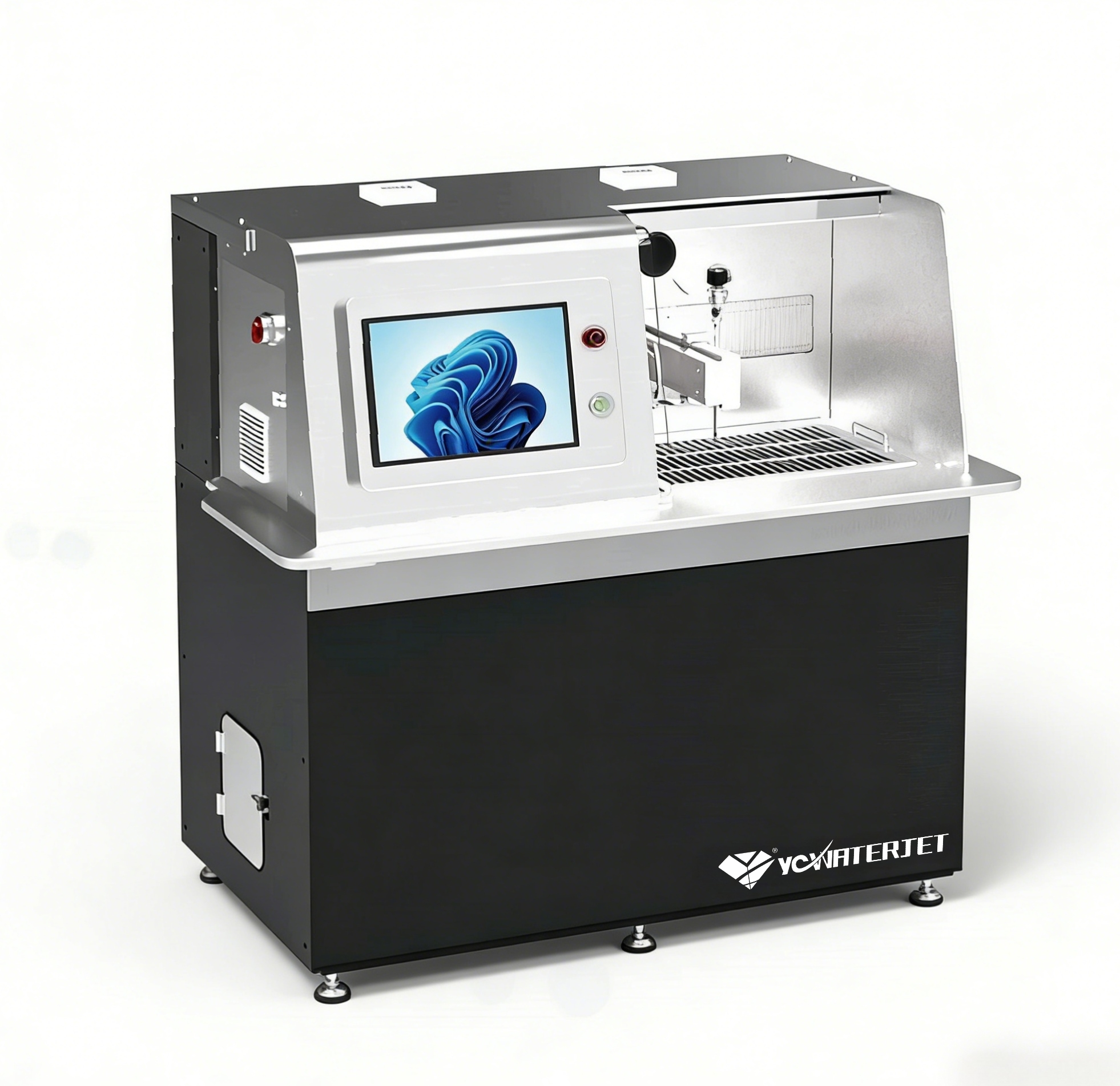
The S Series is a full-closed small CNC waterjet cutting machine. It is designed for users who need a compact unit, either for small workshop spaces or for applications such as food cutting. For metal and stone workshops with standard sheet sizes, the L Series is usually the starting point. For heavy plates or very long parts, the G Series provides larger gantry travel. The E Series offers a integrated configuration for production environments that need a balance between table size and floor space.
Step 2: Match the Pump and Pressure to the Material
The ultra-high-pressure pump determines how fast and how effectively the machine cuts. YC Waterjet machines are rated at a maximum pressure of 4137 bar (60,000 psi). The working pressure is typically 340 MPa. For most cutting work at this pressure level, the pump is a critical component because it determines water flow and orifice/nozzle size compatibility.
For the S, L, and G Series, the maximum water flow is 7.4 L/min. The maximum power is 100 Hp (75 kW). The E Series has a working pressure of 340 MPa with a maximum water flow of 3.7 L/min. This difference matters: a higher water flow with the same pressure delivers more cutting power and faster cutting on thicker materials, while a lower flow machine is sufficient for lighter production loads.
For industrial applications that cut stainless steel or carbon steel, the pump must maintain stable pressure over long cycles. YC Waterjet produces its own Ultra High Pressure Waterjet Pump series under the YCG models, including YCG-3038, YCG-3742, YCG-3742S, YCG-Ultra100, YCG-SERVO50, YCG-Ultra100S, and YCG-Servo50S. The same pump line also supports systems built with Hypertherm intensifier technology. Since 2005, YC Waterjet has collaborated with KMT (Germany) and Accustream/Hypertherm (USA) to integrate advanced pump technology into its systems.
For cutting thick stainless steel or carbon steel, choose a machine with the higher water flow capacity (7.4 L/min). For precision parts on thinner materials, the lower water flow of the E Series can still deliver acceptable cycle times while reducing pump wear and energy consumption.
Step 3: Choose the Axis Configuration for the Part Geometry
Waterjet machines are not all three-axis machines. The cutting head configuration determines whether you can cut bevels, 3D contours, or parts with sharply angled edges.
YC Waterjet offers three axis configurations:
- 3-axis waterjet cutting machine — standard flat cutting with vertical cutting head; suitable for plates, sheets, and parts that do not require angled edges.
- 3D MAX 5-axis waterjet cutting machine — tilting cutting head for bevel cutting and 3D shapes; useful for edge preparation, weld bevels, and countersunk holes.
- Dynamic 5-axis waterjet cutting machine — dynamic compensation for taper and angle control; used for high-precision parts where the cut edge angle must remain consistent.
If your project only requires vertical cuts on flat plates, a 3-axis machine is enough. If you produce parts that need a beveled edge for welding or assembly, the 3D MAX 5-axis configuration or the Dynamic 5-axis system should be evaluated. The Dynamic 5-axis system reduces taper on thick materials, which improves dimensional accuracy for engineering components.
For the G Series and L Series, YC Waterjet also offers double or multiple cutting heads. This configuration is used when you need to cut several identical parts at the same time from a single sheet. It increases productivity for batch production without increasing the machine footprint.
Step 4: Determine the Cutting Accuracy Your Project Needs
All YC Waterjet S, L, G, and E Series machines are specified with a cutting accuracy of ±0.1 mm and a positioning accuracy of ±0.025 mm. This means that the positioning system is more precise than the cutting process itself. The cutting accuracy depends on the material thickness, the abrasive quality, the cutting speed, and the workpiece stiffness.
For most precision fabrication work, ±0.1 mm is a practical guarantee. If the project requires tighter tolerances, the real limitations usually come from the material and the cutting speed, not from the machine positioning. Use a Dynamic 5-axis head for parts that need consistent edge angles, and use lower cutting speeds for the final contour pass when edge quality is more important than cycle time.
Step 5: Match the Machine to the Workflow and Environment
A waterjet cutting machine does not work alone. The workflow around the machine determines how productive it will be:
- Material loading: For L Series machines, an optional hydraulic loading system is available. This is useful when you regularly cut large or heavy sheets.
- Sludge and abrasive removal: An automatic sludge removal system is available for G Series and other configurations. This reduces manual cleaning time and keeps the tank operating at full volume.
- Height measurement: Laser scanning height measurement is available as an option. It helps keep the cutting head at a consistent standoff distance when the material surface is not perfectly flat, such as with stone, textured plates, or warped sheets.
- Drilling function: A cutting head with a drilling function can perform start holes without a separate drilling operation. This is valuable when cutting hard materials like stainless steel or thick stone.
- Multiple cutting heads: For batch production of simple parts, multiple heads can cut several parts in one pass.
For dust-free environmental cutting, the machine must be positioned in a clean production area. The cutting process itself uses water to suppress dust, but the surrounding workflow should still be designed to handle abrasive sludge, water treatment, and maintenance access.
In terms of environment, YC Waterjet configured systems are designed for normal temperature and pressure conditions. This is important because the machine can be installed in a standard production workshop without special climate controls, as long as the pump room is ventilated and water supply quality is maintained.
Step 6: Consider Lead Time and Customization for Project Deadlines
If your project has a fixed deadline, lead time is part of the machine selection. YC Waterjet offers OEM/ODM customization for logo, cutting head, cutting area, cutting speed, voltage, cutting thickness, and height measurement. The production capacity is 10 sets per month, with a typical lead time of 30–45 days and a minimum order quantity of 1 set. Each unit undergoes delivery inspection before shipment.
For standard models with available configurations, the lead time is shorter. For custom cutting areas or a customized cutting head, the 30–45 day window should be planned into the project schedule. If you need a customized voltage for a specific market, confirm the voltage configuration with the supplier before the production starts.
Comparison: Choosing Between Small, Stone/Metal, and Large-Format Systems
| Project Scenario | Recommended Configuration | Why It Matches | Material / Part Examples |
|---|---|---|---|
| Prototyping, small parts, food cutting | S Series (YCWJ-S0808/1010/1212) | Compact footprint, full-closed design, waterjet food cutting option | Small metal parts, rubber, frozen food, composites |
| General metal and stone fabrication | L Series (YCWJ-L3020/L4020) | Mid-size cutting area, 3-axis or 5-axis options, hydraulic loading available | Stainless steel sheets, aluminum plates, marble, granite, glass |
| Heavy plates, long parts, ship and defense | G Series (YCWJ-G2060/G30100) | Large gantry, double/multiple cutting heads, 5-axis options | Thick steel plates, titanium, ship panels, armor |
| Integrated production line | E Series (YCWJ-E3020/E4020) | Machine + CNC + high-pressure pump integrated | Carbon steel, stainless steel, production series |
| Bevels, 3D contours, taper-sensitive parts | Dynamic 5-axis or 3D MAX 5-axis | Tilting head and taper compensation | Weld bevels, aerospace parts, molds, architectural details |
| High-volume identical parts | Multi-head configuration | Several parts cut simultaneously | Metal gaskets, brackets, stone tiles |
Real Project Examples from the Field
YC Waterjet machines are used across industries where project requirements vary significantly. In Thailand, an industrial manufacturing customer uses a YC Waterjet robotic waterjet cutting system for precision part cutting. The machine has been operating for 10 years, cutting industrial parts with high accuracy, reducing scrap, and improving production efficiency. The key requirements were high-precision cold cutting with no thermal deformation, reliable performance in a tropical climate, and versatility across diverse industrial materials.
In Germany, a home furniture manufacturer uses a YC Waterjet system for stone and marble cutting. The machine handles marble and stone furniture components with clean cuts and zero chipping. The operation runs with low noise and dust-free cold cutting, which suits a premium furniture workshop environment.
In Mauritius, a yacht manufacturer uses a YC Waterjet G Series double gantry 5-axis system, model YCWJ-3742S-G2565MAX5DG, for yacht aluminum plate cutting. The system has been in service for 10 years, producing clean, burr-free precision cuts that meet marine-grade standards. Cold cutting preserves the material strength of the aluminum without thermal deformation.
In Austria, a diamond processing manufacturer uses YC Waterjet equipment for Swarovski crystal processing. The system delivers precision cutting performance with zero thermal damage, high-yield complex processing, and stable long-term operation. The customer selected a customized solution for the luxury industry, emphasizing low-noise and eco-friendly operation.
These examples show that a waterjet cutting machine is usually selected for a specific combination of material, environment, and production duration. In all these cases, the machine operated for 10 years, which points to the importance of structural stability, pump reliability, and manufacturer support.
Before You Order: A Project-to-Machine Checklist
- Confirm the largest workpiece footprint and choose a table size that leaves room for the abrasive cutting path and part unloading.
- List the materials you will process, because metal, stone, glass, composites, and soft materials all have different cutting speeds.
- Measure the maximum material thickness and decide whether you need the 7.4 L/min high-flow pump configuration or the 3.7 L/min E Series configuration.
- Check whether the parts require bevel cuts or taper control; if yes, request a 3D MAX 5-axis or Dynamic 5-axis cutting head.
- Verify the machine accuracy requirements against the ±0.1 mm cutting accuracy specification.
- Calculate the cycle time from cutting speed, material thickness, and part count to determine whether a multi-head configuration is justified.
- Plan the workshop layout for dust-free operation, sludge handling, and pump access.
- Confirm the delivery date based on the 30–45 day lead time for custom machines and the 1-set MOQ.
Frequently Asked Questions
Can I use a waterjet cutting machine for both metal and stone in the same workshop?
Yes. Waterjet cutting machines cut stainless steel, carbon steel, stone, ceramics, glass, and many other materials. The machine itself is not material-specific. For a mixed metal and stone workshop, the L Series is a common choice because the cutting area fits standard 3×1.5 m or 4×2 m sheets and plates. You may need to adjust the cutting speed and abrasive type depending on the material, and the workshop needs effective sludge removal because metal and stone produce different types of abrasive residue.
What is the difference between a 3-axis and a 5-axis waterjet cutting machine?
A 3-axis waterjet cutting machine moves the cutting head in X, Y, and Z, which allows vertical cutting of flat plates. A 3D MAX 5-axis machine adds two rotational axes, allowing the cutting head to tilt for bevels and 3D contours. A Dynamic 5-axis machine also compensates for taper and maintains a controlled edge angle during cutting. For flat parts with straight edges, 3-axis is sufficient. For weld bevels, countersunk holes, or angled edges, choose a 5-axis system.
What is a small waterjet cutting machine suitable for?
A small waterjet cutting machine such as the S Series is suitable for prototyping, small precision parts, food cutting, and workshops with limited floor space. The S Series models are YCWJ-S0808, YCWJ-1010, and YCWJ-1212. They provide the same cutting accuracy of ±0.1 mm as larger YC Waterjet machines, and they can be configured for food cutting or a fully closed CNC enclosure. Small waterjet machines are not designed for very large plates, but they are a practical option for small-part production and product development.
What does “no thermal deformation” mean for waterjet cutting?
Because waterjet cutting uses a high-pressure stream of water mixed with abrasive, the material is cut by erosion rather than by heat. The workpiece remains at a normal temperature and pressure during the process. For metals, this means the cut edge does not develop a heat-affected zone, and thin or heat-sensitive materials do not warp. For stone, glass, and composites, it also means the material does not crack from thermal stress.
What is the typical delivery time for a customized YC Waterjet machine?
For a customized machine, the typical lead time is 30–45 days after order confirmation. YC Waterjet's monthly production capacity is 10 sets, with a minimum order quantity of 1 set. Each machine goes through a delivery inspection before shipment. After delivery, the one-year warranty covers the machine excluding consumable parts, and free replacement parts are shipped for non-manual defects. Remote guidance with manuals and video support is included, and on-site engineer assistance can be arranged for split-type waterjet machines with costs borne by the client. If your project has a fixed deadline, confirm the lead time with the sales team before placing the order.
Final Thoughts
Selecting the right waterjet cutting machine is a project-scope exercise. The machine must fit the material, the part size, the edge quality requirements, and the production workflow. The YC Waterjet S, L, G, and E Series provide different table sizes, axis configurations, pump flows, and optional functions so that the machine can be matched to the actual cutting task rather than selected on price alone.
For projects that require a specific cutting area, cutting head, voltage, or height measurement, YC Waterjet supports OEM/ODM customization with a 30–45 day lead time. If you are evaluating a machine for a specific application, contact YC Waterjet with your material type, maximum part dimensions, and production volume to confirm the recommended table size and axis configuration.
To discuss a waterjet cutting machine configuration for your project, contact YC Waterjet at www.ycwaterjet.com or email sales@ycwaterjet.com for a sample, quotation, or technical inquiry.
Have Questions or Need More Details?
Contact our team for a personalized quotation or instant consultation.
Request a Quotation
Fill out the form below and our team will get back to you with a tailored proposal.
WhatsApp Direct Chat
Prefer to chat in real-time? Message us on WhatsApp for instant assistance & quick answers.
- Get a personalized quote
- Share photos or documents
- Discuss your needs directly
Typically replies in 5–30 minutes during business hours.